SETH GELBERT
Portfolio
During my elventh grade year , I have made great strides in becoming more prepared for college. I grew in many different topics over the course of the year. In Goverment, I grew in my ability to argue a posistion using a argumentative essay. In Algebra 2, I grew in my knowledge of polynomials. In Chemistry, I grew in my ability to convert different units. In Technical Reading and Writing , I grew in my ability to use context clues. The sections below go into more detail upon my growth, each class, and the artifacts of my eleventh grade year!
Goverment
In my government class this year, I would say the most important thing that I learned was how to use legal documents to express what I belief in and how I should argue for a certain position. After learning how to use the legal documents to our advantage and how to argue a position, I am better suited to write an argumentative essay to express what I belief in. I think learning how to write an argumentative essay will better me in writing any kind of essay in the future, like in college. One project that could show this growth would be the Matthews Bill Project. The goal of this project was to argue for the bill, and why the bill should be passed.
To first introduce this project, it started in 2014 as an idea from one of the intervention specialist at our school. It has now turned itself into a bill and is making a run to becoming a law. The Mother of Matthew, who is a recent intervention specialists’ at our schools, has a son who has been diagnosed with multiple disabilities from birth. Matthew and his family have struggled from day one to be out in public with him and enjoy being out. Since Matthew is disabled, he wears a diaper and needs to be changed every now and then. Every human with age, comes an increase in the size and weight so it makes it hard for the parents of Matthew to change him. When he was little, it was just an easy change in the car, but now it could take up to 30 minutes just to change him. This bill is asking for all public facilities to install an adult changing table for disabled people just like Matthew. The purpose of the project was to write an argumentative essay supporting this bill while using certain legal documents to support your argument as evidence. If you did not support this bill, you would have a alternate bill to argue for. There were four objectives to be met during this project: convince the Senate State & Local Government Committee to send our bill to the Senate Floor for a vote, convince a member of the House, Niraj J. Antani (District 41, R), to introduce a campaign bill, update all campaign materials and get more organizations and institutions openly supporting SB112. The documents that were required to use were the Ohio Constitution, Americans with Disabilities Act, Declaration of Independence and the Federal Constitution. The essay also had to be completed in APA format. Even though this may seem like a lot is was guided very well.
The first artifact to support my growth is the Argumentative essay. This essay shows how I used the legal documents to express my belief and arguments. At first when I attempted to try and find evidence for this essay, it was really challenging because I didn`t know how to effectively use the documents. I struggled finding evidences that was strong and also would work well with the essay. After getting critique outside of class from a few classmates, I was ready to compile all the evidence I needed. As the semester went on, I learned how to use the evidence that was in the documents in an effective way. That is why I am using this artifact because it shows my growth and how I used what I gained over the semester to argue my position on the essay.
The second artifact is the outline that I used to help me compile and construct evidence for the essay. This allowed me to write what I thought would make my essay stronger down and locate evidence while also tracking what source or document that I got the information from. This really helped me a lot. This proves my growth because it allowed me to gain the knowledge of the evidence that I needed to argue for. As the process of writing went on, I continued to look back at the outline for major points that I needed and to see if there was anything else I could add.
The most challenging part of this was making sure my arguments were strong and had strong evidence to back them up. If your arguments did not have strong evidence, then your arguments were probably not that well written. This step really made me dig for a good and strong piece of evidence for each argument. I would say the success I had in this would be being confident with my arguments and being proud of my essay. This was a really long process and took a lot of effort. Although it was a long process I learned quite a bit. Some new vocabulary was introduced in this unit. One of them being necessary and proper clause. The definition of this word is “A section of the United States Constitution that enables Congress to make the laws required for the exercise of its other powers established by the Constitution.” We used this to determine whether Matthews Bill was a necessary and proper law. The next vocab we learned in this was 1-21 amendments of the constitution. This was really helpful throughout both projects because it gave us knowledge we needed about the rights that citizens of the United States have. The next helpful word I learned was a filibuster. I learned this during the legislative topic in class, when I learned how a bill would become a law. This was helpful because Matthews’s bill is a bill that my class is trying to get it passed and turned into a law. A filibuster is “an action such as a prolonged speech that obstructs progress in a legislative assembly while not technically contravening the required procedures.” It was cool how my teacher explained what a filibuster was because she gave really good examples and I even had a reading to complete about one. I feel that I invested a lot of time into it and it really paid off. This was a really fun and challenging project and I hope this bill will soon get turned into a law.
Algebra 2
So the goal for this project was to create an equation that graphed a roller coaster. This project was a replacement for a chapter test, which I really liked. This project involved material and or information that we are learning from chapter 8. Chapter 8 consist of expanding our knowledge of the family of functions in which we learned in Chapter 3 to include polynomials functions. After completing this project and learning the context of chapter 8, I gained more knowledge about polynomials.
So the steps leading up to this project were a little long. First we started with the normal classwork. This helped us get a feel for the work and made us more familiar with functions again. We also were given homework problems throughout the chapter for extra practice. Notes and some class or team table discussions also took place to get others opinion on a problem or to justify a problem. Next we had an individual quiz. One thing that really helps me is we are allowed to use the notes we took during class on the quizzes. It also gets the students motivated and want to take notes, so they can have that advantage on the quiz, which is really cool. Some notes would just consist of terms that we needed to know. The three most important terms that I learned is polynomial, coefficient and degree. A polynomial is an algebraic expression that involves at most the operations of addition, subtraction, and multiplication. A coefficient is when variable(s) are multiplied by a number, the number is called a coefficient of that term. Lastly One degree is an angle measure that is 1/360 of a full circle or pi/180 radians. After the quiz we were able to choose one other classmate to work on this project with. We had three class periods spread out over three days to complete this project, which comes and goes pretty quick. I feel this project was really simple, but a little time consuming. There were only three requirements for this project. The rollercoaster at to start at 250 feet, the ride length had to be at least 4 minutes, the coaster had to have at least 2 relative maxima and or minima and it had dive below the ground into a tunnel at least once.
For my first artifact I will use the poster itself. This project was worth 75 points, but it had a twist. Since our grades are weighted, this project was really worth a lot more. So that means doing well and understanding the material was a must. The hardest part of this project, or what took the longest was coming up with an equation that met all the requirements and still made a good looking rollercoaster. This part of the project took more than one class period to figure out. A few websites that were given to us by the teacher were used to help us out. We had to look back in the book a few times to refer to past info about polynomial functions and also make sure the max/min of the graph was correct. This shows that the process leading up to this project helped me gain the knowledge needed in order to complete this project.
For my second artifact I will use the project outline paper. This was a great tool to have during the project. It allowed us to see what needed to be on the poster or final piece. It was sort of like a checklist. The cool part about the outline is that it gives every single piece of information that is needed. The reason this artifact proves my growth is on the outline itself it uses words like degree and polynomial. Now if I didn’t know what these words meant or what it had to do with the project, I would be in a little trouble. This shows that learning previous lessons and part of lesson 8 expanded my knowledge about polynomials.
I really enjoyed this project a lot. One reason I enjoyed is because I love amusement parks and rollercoasters. I still think the class should have token an informational field trip to Kings Island to get to know rollercoasters a little more. On A serious note I really think I learned about polynomials in a fun and special way.

This is the outline I used to help me with my project.
This is the outline I used to help me with my project.
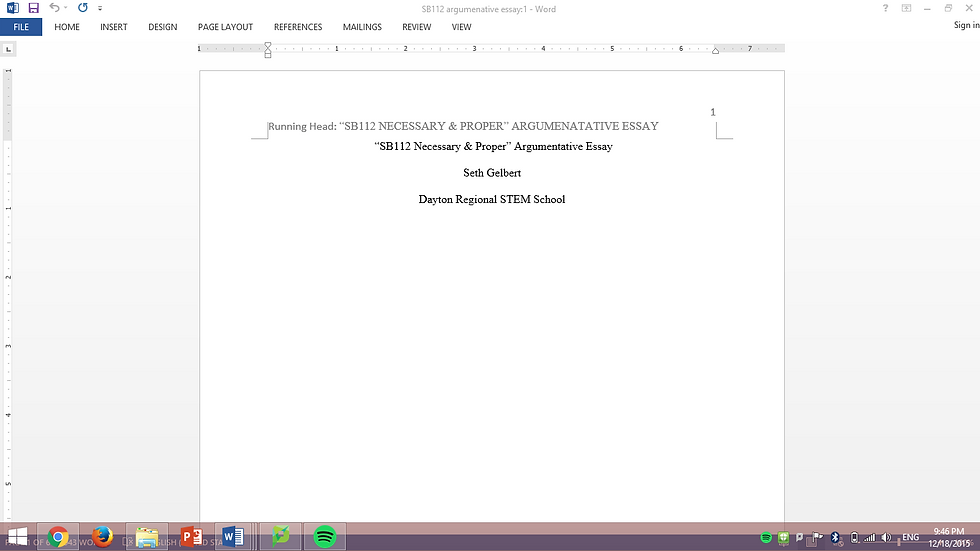
The essay I wrote for Government class

Essay

essay
The essay I wrote for Government class

The poster that was made for this project
The poster that was made for this project

Outline and Requirements

Outline and Requirements
Outline and Requirements
Chemistry
The first unit we learned in Chemistry was the Mole Unit. I feel that the goal or purpose of this unit was too be able to understand how to convert between different units. To ensure that I passed this unit I needed to be focused. After practicing and studying during the mole unit I am better suited for college. Knowing how to convert certain units with certain formula is very important to me and will help better prepare myself for the future because I could see myself using this math in college
The first thing we did was Molar Mass. Molar mass is the weight of the mole. The equation you use to remember the weight is 6.02 x 10^23= 1 mole. That number was very important in this unit. Another important step I learned in that PowerPoint was converting between grams and moles and moles to grams. This step was a little confusing at first but once you practiced it enough it became 2nd nature. There was an easy way to set up the calculations which you will see later in one of my artifacts. The next big step we took was learning % composition. A good example of percent composition would be if you got 3 questions wrong on a test of 56 question what is your grade in %? The way to figure this out would be to take the number of questions you answered correctly (53) and divide that by the total number of questions (56). The answer you would get is about 95%. But we were finding the % composition of an element. The formula for that is the mass of the element in grams divided by the molar mass of compound multiplied by 100. I felt this was a very easy step to learn. Next we learned that testing an unknown substance, often uses a mass spectrometer. The MS separates and identifies each of the elements present in the compound. Also the MS reports % composition of each element. We used this to find the empirical formula. To find the empirical formula there are four easy steps. The first step is to change % to grams of each element. Second convert each gram to moles. Next divide each number of moles by the smallest number of moles. Then finally use the ratio to find the formula. The next formula we learned is the molecular formula. The molecular formula is simply n (empirical formula). To find the molecular formula you first have to find the empirical formula. Then you have n = the molar mass of the empirical formula. Third you would find molar mass of molecular divided by molar mass of empirical. Finally you multiply all parts of the empirical formula by n. the last thing we learned to do was find the formula of a hydrate. A hydrate is a anhydrous salt with the water attached, symbolized by XX multiplied by any given number of H2O. I know that might be a lot to take in, but I really think it improved my knowledge by practicing and studying all that was in the mole unit, I am better suited for college classes that involve this kind of math.
One Artifact to prove that I am better suited for college classes by studying and practicing the Mole Unit is the Solving the crash lab. For this lab we played the role of a CSI team called to the scene of a plane crash. When we arrived at the scene the plane showed evidence of a pre-crash explosion. The site of the explosion has a compound with the following chemical analysis: 37.01% carbon, 2.22% hydrogen, 18.50% nitrogen, and 42.27% oxygen. We also found that the victims were found around the crash and had to be identified by the substance found in their belongings or in their bodies since dental records were not available. And further evidence revealed that one person was murdered with the time of death established as one hour before the crash. My job was to use percent composition data to determine the empirical formula and identify the compounds found on each victim of the crash. One step that I really had to focus on was convert the % composition into the empirical. Without doing that step correctly it would have messed all of my data. A second part of this artifact would be the work and formulas I did to find the data.
Another artifact that really helped me along this unit would be some of the many notes that were taken during this unit. Without the notes none of the studying, practicing, or even the homework would have even helped me. This was also a great studying tool along with homework. I would use the notes to refer back to while doing homework to refresh my memory. Again this shows that I was to study my notes and practice using homework to have a better understanding on this unit. Having a better understanding of this unit gave a step forward in the future as well, so I will a step ahead in my college classes involving this kind of math.
To conclude this reflection, I really enjoyed this unit even though there were times of struggle. I would say the most challenging part of the unit was converting moles to molecules. I don’t know why but I seemed to really struggle with it which made me practice and study even more. I would the success in this unit would be learning how to convert this kind of math. Not only will I need this kind of information for the rest of this year’s chemistry class, but even in future classes like college chemistry. Also as I do it more and more I will gain even more knowledge to better prepare me for college.
Technical Reading & Writing
In my Technical Reading and Writing class we completed vocab workshops on context clues. After practicing and studying context clues to better understand the meaning of words in a sentence I am better suited for reading and learning new vocabulary from textbooks in college. The goal of the workshops was to pass the test because knowing context clues is very important, and will help me better prepare for the work that is involved in college. I feel that I will be need to know what context clues are in college especially because I believe that in college related textbooks there are going to be long complicated words that I may not understand.
To begin the workshops e were first given a Vocabulary in Context packet to get us started on learning about context clues. This helped me get a feel for Context Clues and what to expect in the future when I am in college. In college there are going to be many times where I am not going to know what a word means. It will save time when reading, so I don’t have to look the words up to find their meaning. This packet also informed me about the three different types of context clues: The three types are example, synonym, and antonym. Examples may suggest the meaning of an unknown word. So for example if the sentence was ‘His duplicity involved lowering his employee's salaries, increasing their stock options, and then stealing the money he saved by doing so.’ They give examples of the meaning of the word duplicity. Synonym might use a word that has a similar meaning of the vocab word, and antonym will use the opposite meaning. Second we were given a packet called the General Sense of the Sentence or Passage. In this packet it would give you a sentence with the vocab word in italicized font. There were four choices each sentence to choose the correct meaning of each word. In another section of the packet we had to write the definition of the italicized word. This made me dig a little deeper to find out the meaning of the unfamiliar words. In some cases I was making conclusions based on the information given with the word. Also it might help using the synonym and antonym and substituting it in for a word in the sentence to see if it makes sense. This is a great tool to be able to use while trying to find the meaning of a word. Next, we were given the test, which I couldn’t wait to take because I felt so good about it. I felt step 2 was the most important step because it really prepared me for the test. Like I said before it made me dig a little deeper and gave me a challenge which helps me learn more. It also helped me a lot because it made me think of questions to ask myself while looking for the context clues. That was also a great tool to use on the test because it was very simple and easy, which made the test feel like a breeze.
For my first artifact that demonstrates my new knowledge of context clues is the practice packet we did in class before the test. This really helped me because it gave me a challenge but it also really improved my knowledge on context clues. I even used this packet to study the night before the test. Studying for a test or quiz has always been a struggle for me. Having this packet allowed me to look at examples that could be on the test. This shows growth because it proves that I was taking the time to complete class workshops and practice packets to understand context clues more. This also shows growth because it will help me in college a lot even if I didn’t find the context clue in a textbook, it still shows that I am able to work with context clues to better my knowledge.
For my second artifact I will use the actual test. This shows that I passed with a 23/21. I was glad I attempted the extra credit because trying will never count against me. Also I felt that extra practice would be a good help. This shows that I am able to study context clues because if I passed the test then it shows that I knew the content. I think that by showing that I passed the test due to completing the workshops and practice packets it also shows that I am capable of reading college textbooks with full understanding of the words in the book, because of the context clues.
The 2nd practice packet was the most challenging for me. It really made me think and dig the answer out, which really helped me out in the long run. Although it was the hardest to complete it was also a fun challenge. Being challenged is good because if you get the correct answer then you really know you understand, but if you get it wrong then it will let you know where you made the mistake. The success I had during the context clues unit would be that I got over a 100% on the test, and was able to fully understand the unit enough to be able to explain it. When I first started this unit I thought it would be a breeze and that I really didn’t need this. But about half way through the unit I was like “Woah”. I noticed that I learned new things and rules about writing and reading. That is why I believe knowing what I know about context clues I am now better suited for college.

context clue test i took

context clue test i took
context clue test i took

packet we did in class

packet we did in class

packet we did in class
packet we did in class

victim lab work

victim lab work

victim lab work
victim lab work

mole notes that helped get me through the unit
mole notes that helped get me through the unit
I really enjoyed my junior year. I came into this year with a different mindset than lastyears and I think this work really shows it. I really liked all of these projects, but the one that I feel I grew the most in was Chemistry. I has really helped me alot.